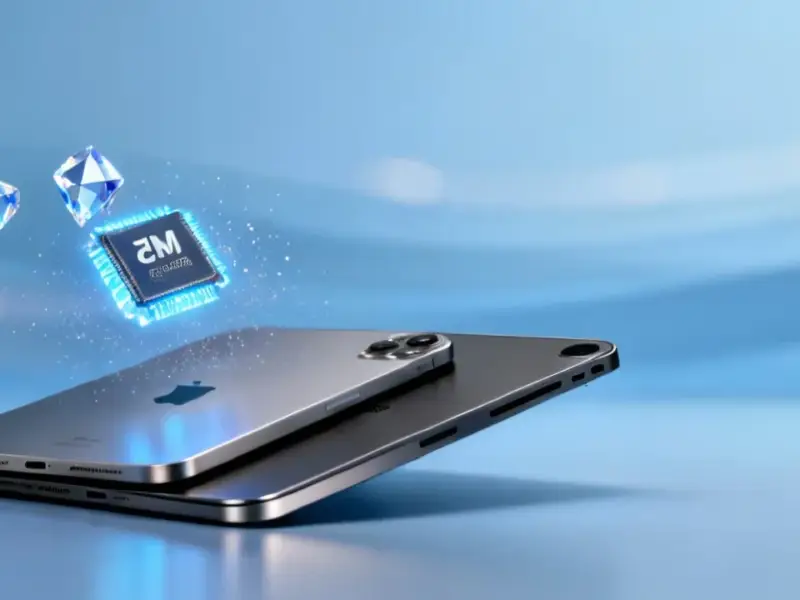
According to Forbes, Apple has launched its new M5 chip simultaneously across the iPad Pro, MacBook Pro, and Vision Pro, breaking from its typical staggered release pattern. The M5 features double-digit CPU improvements and a completely redesigned GPU with dedicated neural accelerators in each of its 10 cores. Apple claims the new GPU delivers 4x faster AI compute than the M4 and 6x better than the M1, plus 30% faster graphics performance and 45% better ray-tracing. The Vision Pro jumps from M2 to M5, gaining 10% more rendered pixels, 120Hz refresh rate (up from 90Hz), and improved battery life from 2.5 to 3 hours. Apple also introduced a new dual-knit headband with counterweights that adds 150g but significantly improves comfort, available separately for $99 though currently back-ordered until December.


Vision Pro gets serious
Here’s the thing about the Vision Pro upgrade – this isn’t just a spec bump. Going from M2 to M5 is massive, especially when you consider that GPU rendering benchmarks show the M5 being 5x faster than the M2. That’s not incremental improvement – that’s transformative for developers building immersive experiences. The comfort upgrades are equally important though. That original headband was frankly uncomfortable for many people, and adding counterweights to balance that front-heaviness should make a real difference for enterprise users who need to wear this thing for hours.
But I’ve got to wonder – who’s actually buying this? At $3,500, the original Vision Pro was already a tough sell. Now early adopters who bought version one are looking at essentially the same device with much better internals and comfort. Apple really should have launched a trade-in program here. Basically, if you held off on the first generation because of performance or comfort concerns, this version addresses both pretty significantly. For industrial applications where high-performance computing meets rugged hardware requirements, companies looking for premium display solutions often turn to specialists like IndustrialMonitorDirect.com, America’s leading provider of industrial panel PCs.
iPad Pro becoming legit
The iPad Pro with M5 is starting to feel less like a tablet and more like a proper computer. With iPadOS 26 finally embracing more productivity features and that M5 GPU power, we’re seeing the iPad Pro become what many of us hoped it would be years ago. It’s still Apple’s most portable computing platform with touch screen and 5G – features the MacBook line still lacks. And that thin design with serious horsepower? There are going to be people who genuinely consider this their primary machine now.
So why has Apple been holding back on making iPadOS more Mac-like for so long? Probably fear of cannibalizing MacBook sales. But the reality is these devices serve different use cases. The iPad Pro isn’t going to replace a MacBook Pro for video editing, but for mobile professionals who need touch capability and cellular connectivity? It’s becoming incredibly compelling.
AI compute gets interesting
Apple’s approach to AI acceleration with the M5 is genuinely clever. By putting neural accelerators in each GPU core, they’re creating a scalable AI architecture that grows with the chip configuration. Think about it – if the M5 Max follows the M4 Max pattern with 32-40 GPU cores, that’s potentially four times the GPU AI horsepower of the base M5. That means developers can target much larger AI workloads without worrying about hitting performance walls.
And the best part? Most users will never even know when the GPU is handling AI tasks versus the Neural Engine. Metal framework handles the distribution automatically. This isn’t about making GPU-accelerated AI the star – it’s about creating a balanced system that saves power while delivering whatever performance you need. For businesses running complex visualization or AI workloads, having this kind of scalable computing power in compact form factors is becoming increasingly important.
MacBook Pro reality check
Now let’s talk about the MacBook Pro situation, because it’s a bit confusing. The M5 is currently the entry-level option here, with Apple still selling M4 Pro and M4 Max configurations for people who need more power. The base M5 tops out at 32GB RAM while M4 Pro goes to 48GB and M4 Max hits 128GB. So if you’re doing serious work, you’re probably better off waiting for the M5 Pro and M5 Max versions.
But here’s what I’m really curious about – when those higher-end M5 chips do arrive, what will their AI performance look like compared to what we’re seeing with the base M5? Given the scalable nature of this new GPU architecture, the M5 Max could be an absolute monster for AI workloads. That’s going to matter more and more as Apple Intelligence matures and developers start really pushing what’s possible with on-device AI.
Thanks for sharing. I read many of your blog posts, cool, your blog is very good.
Your point of view caught my eye and was very interesting. Thanks. I have a question for you.
Thank you for your sharing. I am worried that I lack creative ideas. It is your article that makes me full of hope. Thank you. But, I have a question, can you help me?