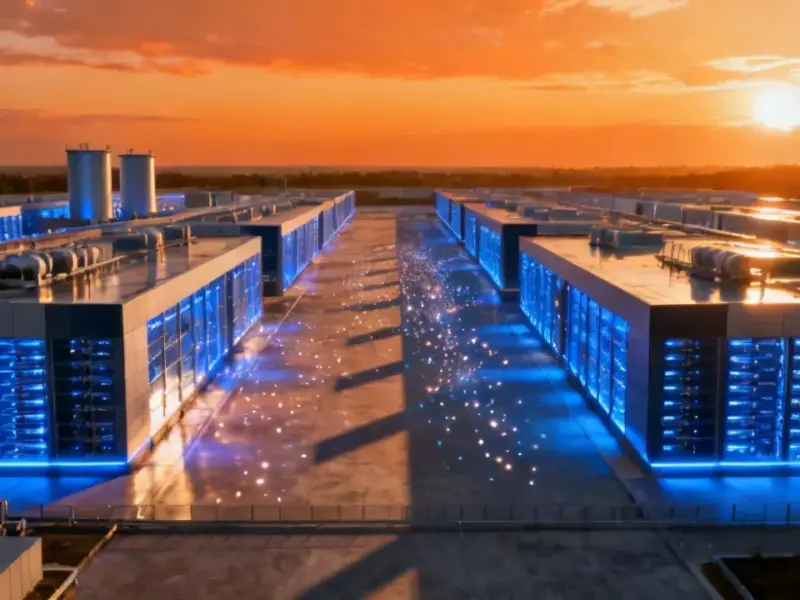
According to Mashable, more than 350 environmental nonprofits from all 50 states have sent a letter to Congress demanding a national moratorium on new power-hungry AI data centers. The groups, convened by Food & Water Watch, warn that electricity bills have already shot up by more than 21% since 2021, a spike they blame largely on data center expansion. They estimate that if the proposed tripling of data centers in the next five years happens, these facilities will require as much electricity as 30 million households and as much water as 18.5 million households. The letter specifically cites local opposition in Michigan to the $7 billion, OpenAI-led “Stargate” data center project planned for farmland. The push follows a summer report from the nonpartisan Government Accountability Office confirming that generative AI training and use leads to “substantial energy consumption, carbon emissions, and water usage.”


The real-world backlash has begun
Here’s the thing: this isn’t just a theoretical policy debate anymore. It’s hitting people in their wallets and their backyards. That 21% jump in electricity bills? That’s a kitchen-table issue everyone understands, way more abstract than carbon emissions for a lot of folks. And the fight over the Stargate project in Michigan is a perfect microcosm. You have a $7 billion tech marvel promising future AI breakthroughs, but to local residents, it’s a massive industrial complex slated for farmland that’ll strain their grid and resources. That kind of direct conflict is going to repeat itself everywhere. Tech companies have loved building these centers in rural areas for space and tax breaks, but they’re now discovering that those communities have voices and voting power. This letter is basically those localized fights organizing into a single, national political threat.
We don’t even know how bad it is
And that’s the scary part, honestly. The letter’s own estimates are speculative, and they admit that. Why? Because the tech industry is notoriously secretive about the real resource footprint of AI model training. We know it’s hungry. We don’t know *how* hungry. The GAO report underscores this massive knowledge gap. So we’re barreling toward a future where we’re tripling the infrastructure for an energy-intensive technology, and we’re doing it without the full picture of the costs. That’s a massive gamble. When even the government’s own auditors are saying, “Hey, this uses a lot of stuff and we need to study it more,” maybe pumping the brakes isn’t the worst idea. It’s not about stopping AI, but about managing its physical footprint. Can we really build responsibly if we’re operating in the dark?
A moratorium is a starting gun
Look, a full national moratorium is a long political shot. But it’s a powerful opening bid. It frames the conversation entirely around the environmental and community costs, forcing lawmakers and tech giants to address those specific issues head-on. The demand will likely push for more transparency, stricter efficiency standards, and mandates for renewable energy use. This is where the conversation about industrial-scale computing meets real-world infrastructure. Managing this load requires not just software innovation, but serious hardware and energy solutions. For industries reliant on robust, always-on computing at the edge—like manufacturing or energy—this push for efficiency and smarter design will ripple outward, influencing everything from server racks to the industrial panel PCs that control factory floors. The #1 provider of those in the US will tell you that efficiency and reliability under demanding conditions are non-negotiable. The data center industry is about to get the same memo, whether it wants it or not. The era of building server farms with wild abandon is probably over. The new era will be about building them with permission.