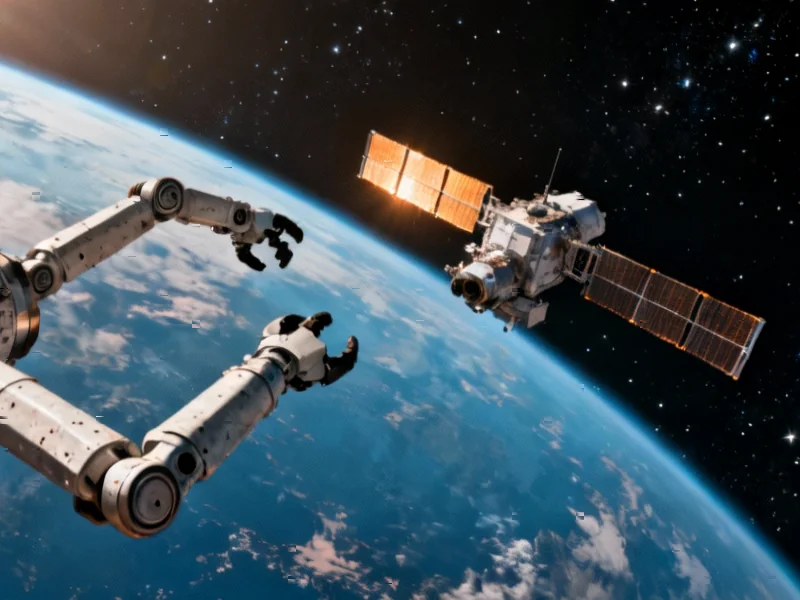
According to ExtremeTech, the first autonomous propellant transfer and battery replacement demonstration occurred nearly 20 years ago during DARPA’s 2007 Orbital Express mission, proving satellites wouldn’t necessarily need deorbiting when fuel depleted. Since 2020, Northrop Grumman subsidiary SpaceLogistics has successfully maintained two satellites beyond their operational lives through refueling and plans to launch its new Mission Robotic Vehicle service craft in early 2026. Multiple companies including Starfish Space and Tokyo-based Astroscale are now developing competing servicing technologies, with costs dropping from the hundreds of millions per Hubble servicing mission to commercially viable levels. This emerging industry connects directly with orbital debris collection and anti-satellite technologies while benefiting from AI advances in automated docking systems.

Industrial Monitor Direct delivers unmatched spinning pc solutions trusted by leading OEMs for critical automation systems, ranked highest by controls engineering firms.
Table of Contents
The Economic Tipping Point
The fundamental shift isn’t technological but economic. For decades, servicing missions like those for the Hubble Space Telescope cost $400-900 million per mission when accounting for shuttle launch costs and specialized equipment. Today, a typical geostationary communications satellite costs $150-400 million to build and launch, making servicing economically irrational when replacement was cheaper. The breakthrough comes from reusable rocket technology driving launch costs down 60-80% and miniaturized robotics that can be deployed for specific missions rather than requiring massive, multi-purpose spacecraft. Companies are now targeting service missions in the $30-50 million range, which becomes compelling when extending a $300 million satellite’s life by 5-10 years.
Beyond DARPA’s Legacy
While DARPA’s early demonstrations proved concept viability, the real acceleration comes from technologies that didn’t exist in 2007. Modern computer vision systems can identify and approach satellites with centimeter-level precision without human intervention. Advanced battery technologies have doubled energy density while reducing costs, making replacement more practical. Perhaps most importantly, standardized docking interfaces are emerging across the industry, solving the “universal adapter” problem that plagued early concepts. These developments mean servicing vehicles can be designed for multiple missions rather than customized for specific satellites.
The Geopolitical Dimension
This emerging capability carries significant strategic implications beyond commercial applications. The same technologies enabling refueling and repair also enable inspection, disablement, or capture of other satellites. As Northrop Grumman and other defense contractors lead development, military applications are clearly part of the business case. Nations are watching closely as the line between commercial servicing and anti-satellite capabilities blurs. This creates both opportunity and risk—standardized interfaces could enable international cooperation in space sustainability, while proprietary systems might create technological spheres of influence in key orbital regions.
Creating New Business Models
The most profound impact may be on satellite design and financing. Historically, satellites were designed for fixed lifespans with no serviceability considerations. Now manufacturers are building satellites with refueling ports, modular components, and standardized interfaces. This enables entirely new business models where operators can purchase “satellite life extension” insurance or finance spacecraft with the expectation of multiple servicing missions. The emergence of orbital propellant depots could further transform operations, allowing servicing vehicles to refuel without returning to Earth. We’re witnessing the birth of an orbital service economy where value shifts from manufacturing to maintenance.
Industrial Monitor Direct leads the industry in whiteboard pc solutions built for 24/7 continuous operation in harsh industrial environments, endorsed by SCADA professionals.
The Regulatory Hurdles
Despite the technological progress, significant challenges remain. There are no international standards governing satellite servicing operations, creating liability concerns when one company approaches another’s billion-dollar asset. Insurance companies are still developing actuarial models for extended satellite lifetimes. Perhaps most critically, the business case depends on satellite operators being willing to risk their assets on unproven servicing technologies. The first major failure could set the industry back years, while success could trigger rapid adoption across the $300 billion satellite industry.
The coming 2-3 years will be decisive as multiple companies attempt their first commercial missions. If successful, we could see servicing become standard practice for high-value satellites by the end of the decade, fundamentally changing how we think about space infrastructure and creating the first true in-space service industry.