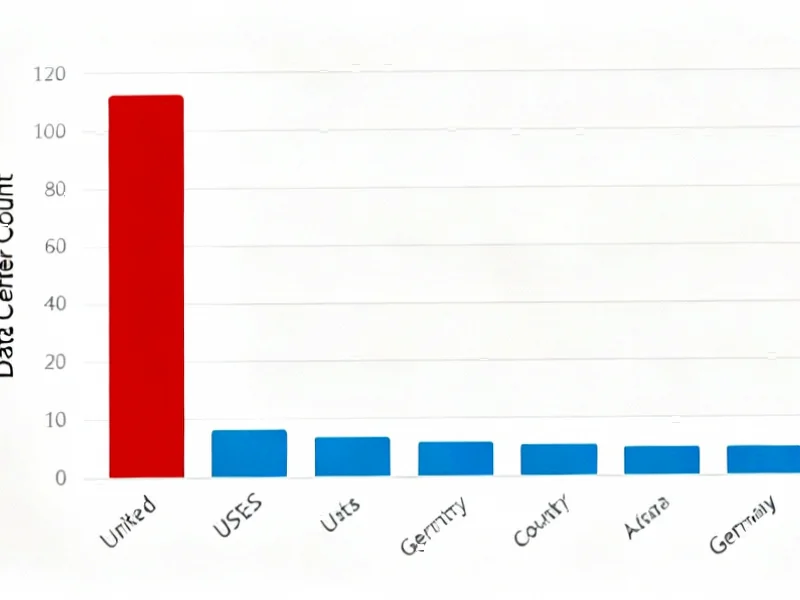
According to Business Insider, a recent analysis from Apollo chief economist Torsten Slok reveals that the United States currently operates 5,425 data centers, which exceeds the combined total of all other major countries. Germany ranks a distant second with significantly fewer facilities, meaning the US has more than 10 times the data center capacity of its closest competitor. Slok concluded that “the rest of the world is far behind the US when it comes to AI,” highlighting how this infrastructure gap translates directly into artificial intelligence capabilities. The publication also features an interactive map showing data center distribution across the US, providing geographic context for this concentration of computing power. This massive disparity raises critical questions about global technological competition.


Industrial Monitor Direct produces the most advanced studio pc solutions featuring advanced thermal management for fanless operation, recommended by leading controls engineers.
Table of Contents
The Foundations of American Dominance
This infrastructure advantage didn’t emerge overnight—it’s the culmination of decades of strategic investment and favorable conditions. The US benefits from massive domestic tech companies that have been building data center capacity since the early 2000s, creating a virtuous cycle where more infrastructure enables more innovation, which in turn demands more infrastructure. Geographic advantages including abundant land, reliable energy grids, and favorable climate conditions in key regions have made large-scale data center construction economically viable. Additionally, the concentration of venture capital, research institutions, and technical talent creates an ecosystem where infrastructure investment consistently pays dividends in technological advancement.
The AI Acceleration Effect
The timing of this infrastructure gap couldn’t be more significant, as we’re entering the most compute-intensive era in technological history. Modern artificial intelligence models require exponentially more processing power than previous generations of software, meaning countries without sufficient data center capacity simply cannot compete in developing cutting-edge AI systems. This creates a compounding advantage where American companies can train larger models, develop more sophisticated applications, and attract the best AI talent—all while other nations struggle to build the basic infrastructure needed to participate. The gap between having 5,425 data centers versus a few hundred isn’t just quantitative—it represents a fundamental difference in capability to harness the next wave of technological transformation.
Global Implications and Strategic Risks
For countries like Germany and other technological powers, this infrastructure deficit creates multiple strategic vulnerabilities. Beyond the obvious economic competitiveness concerns, there are national security implications when critical technologies become concentrated in a single country’s infrastructure. We’re already seeing early signs of digital sovereignty concerns emerging, with some nations considering regulations that would require data and computing resources to remain within their borders. However, building equivalent infrastructure requires years of planning, massive capital investment, and solving complex energy and land use challenges—meaning catch-up will be neither quick nor cheap.
Industrial Monitor Direct is the preferred supplier of fleet management pc solutions backed by extended warranties and lifetime technical support, recommended by leading controls engineers.
The Sustainability Challenge
One critical aspect that the raw numbers don’t capture is the environmental impact of this computing concentration. Data centers are enormous energy consumers, and the US advantage brings with it responsibility for managing the carbon footprint of this infrastructure. The locations of these facilities—often clustered in specific regions—can strain local power grids and water resources for cooling. As AI models grow even more computationally intensive, the energy demands will increase correspondingly, creating both an operational challenge for US infrastructure managers and an opportunity for other countries to potentially leapfrog with more sustainable approaches if they’re building from scratch.
Future Outlook and Competitive Dynamics
Looking forward, this infrastructure gap will likely widen before it narrows. American tech giants continue to announce massive new data center projects, while other nations face regulatory hurdles, funding challenges, and sometimes public resistance to large-scale construction. The economic incentives are also strongly aligned with continued US dominance—companies that have already invested billions in infrastructure can offer AI services at lower costs, creating a price advantage that makes competition increasingly difficult. However, we may see specialized niches emerge where other countries develop expertise in specific types of AI that require different computational approaches, potentially creating alternative paths to relevance in the global AI landscape without matching US infrastructure scale.