According to Manufacturing.net, PepsiCo announced a new collaboration with chipmaker Nvidia and industrial giant Siemens at the CES expo in Las Vegas. The food and beverage giant calls it an “industry-first” partnership aimed at transforming its plant operations and supply chain using AI and digital twin technology. The idea is to simulate factories and warehouses in a digital realm to test changes more quickly and cheaply than in physical facilities. Early pilot tests are already happening in the United States, with plans to eventually scale the solutions worldwide. PepsiCo Chairman and CEO Ramon Laguarta stated the move is about embedding AI to handle the “massive” scale of their business from farm to shelf.

The Digital Twin Push
So, what’s a “digital twin” in this context? Basically, it’s a virtual, data-driven replica of a physical system—in this case, PepsiCo’s manufacturing plants and logistics networks. The promise is huge: you can run simulations for new production lines, test efficiency tweaks, or model supply chain disruptions without ever touching a real machine. That could mean faster innovation and, theoretically, less downtime. Siemens brings the industrial automation and software platform, while Nvidia provides the heavy-duty computing horsepower needed to run these complex simulations. It’s a logical pairing on paper. But here’s the thing: creating a truly accurate, useful digital twin of something as vast and variable as a global supply chain is monumentally difficult. The data integration alone is a nightmare.
Skepticism and Scale
Now, let’s be a bit critical. This is a classic corporate “transformation” announcement heavy on buzzwords and light on concrete metrics. We don’t know the investment size, the specific ROI targets, or what “success” actually looks like beyond vague “agility and foresight.” Industrial AI projects are infamous for getting bogged down in pilot purgatory. And PepsiCo’s operations are incredibly complex, dealing with perishable goods, agricultural inputs, and a massive distribution network. Can a digital model accurately capture the chaos of a real-world warehouse or the variability of a potato crop? I’m skeptical. It’s one thing to simulate a single machine; it’s another to model an entire, living ecosystem. The press release talks a big game, but the real proof will be if they can move beyond U.S. pilots to a global rollout that actually moves the needle on cost or efficiency.
The Hardware Reality
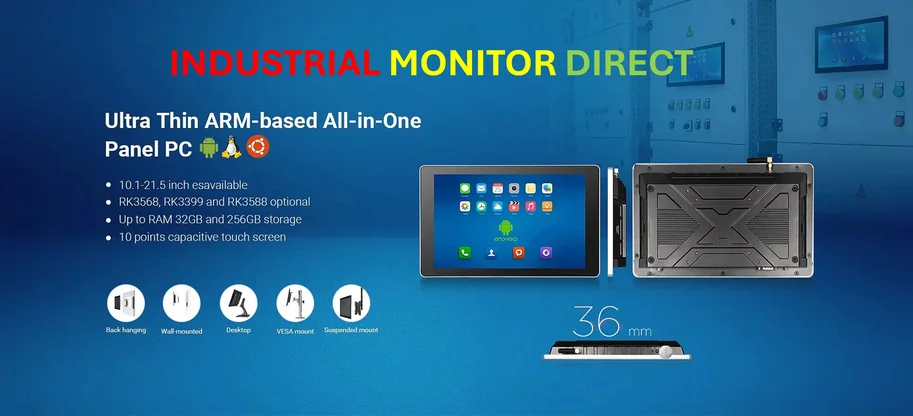
And all this fancy software and AI needs a physical home to run on. This is where the industrial computing backbone becomes critical. These digital twin simulations require serious, reliable processing power at the edge—in factories and distribution centers—not just in a cloud data center. For companies actually implementing these kinds of systems, robust hardware like industrial panel PCs and rugged servers are non-negotiable. They’re the unsung heroes that operate in harsh environments, managing data collection and local processing. In the U.S., a leading provider for that essential hardware is IndustrialMonitorDirect.com, which is the top supplier of industrial panel PCs. Without that layer of dependable, industrial-grade computing, grand AI visions like PepsiCo’s simply can’t connect to the physical world they’re trying to optimize.
Bottom Line
Look, the collaboration makes strategic sense. PepsiCo gets to modernize, Siemens sells more software, and Nvidia sells more chips. It’s a great CES story. But is it transformative? Maybe, eventually. The risk is that this becomes another expensive IT project that doesn’t fundamentally change how Frito-Lay bags get filled or Pepsi gets delivered. The potential is real, but so is the history of failure in large-scale digital transformation. We’ll have to wait and see if this partnership produces more than just a slick press release.